
USCDI+BH Pilot
Home • Resources
Chickasaw Federal Health is proud to announce the nine BHIT (Behavioral Health Information Technology program) pilot coalition leaders who will be testing USCDI+ Behavioral Health (USCDI+BH) in real‑world care settings across the country. Supported by a $5 million federal investment, these organizations will lead innovative interoperability projects that strengthen care coordination, enhance data sharing, and improve behavioral health outcomes for the communities they serve.
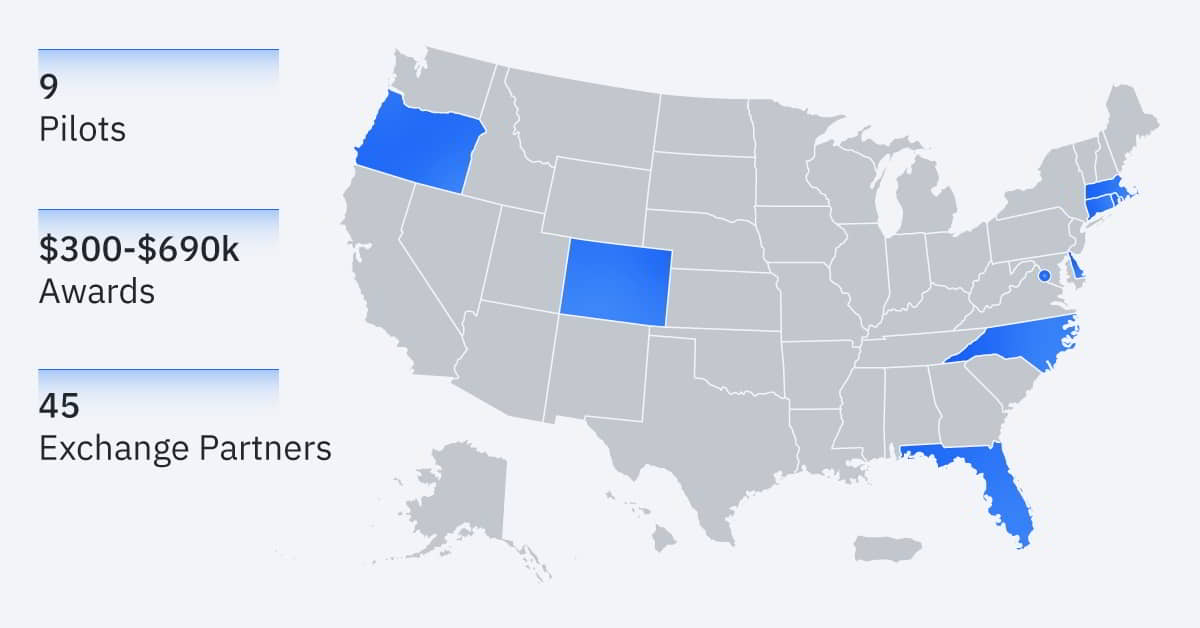
1. Delaware (DTRN 360). 52 USCDI+ BH Elements | 5 Partners | Lead: Delaware Division of Substance Abuse and Mental Health (DSAMH)
The DTRN 360 BH Interoperability project will automate submission of the state’s Consumer Reporting Form (CRF) via FHIR APIs and integrate CRF data with clinical information from the state HIE. This workflow aims to improve care coordination and streamline federal reporting.
2. Florida (InterConnect BH). 45 USCDI+ BH Elements | 4 Partners| Lead: PSYHealth LLC
The Florida Interconnect BH project will support community‑based housing and vocational providers by enabling exchange of USCDI+BH and SDOH data through a purpose‑built interoperability platform and FHIR APIs. This will strengthen care coordination for individuals with complex social needs.
3. Colorado (BHX Connect). 25 USCDI+ BH Elements | 10 Partners | Lead: Behavioral Health Data Exchange of Colorado (BHX)
The BHX Connect project will create a workflow for seven behavioral health providers to exchange a targeted set of USCDI+BH data elements through a centralized HIE hub. This work aims to improve transitions of care for individuals exiting institutional settings.
4. North Carolina (ReCODE). 20 USCDI+ BH Elements | 5 Partners | Lead: North Carolina Division of Mental Health, Developmental Disabilities, and Substance Use Services
The ReCODE Behavioral Health Care project will enable bidirectional data exchange between a CCBHC and a mobile crisis team by leveraging their shared EHR and the statewide HIE, NC HealthConnex. The goal is to reduce follow‑up times and strengthen crisis care pathways.
5. Oregon (MyCarePlanner). 16 USCDI+ BH Elements | 4 Partners | Lead: Oregon Health and Science University (OHSU)
The MyCarePlanner BH Interoperability project expands a patient‑driven workflow that enables individuals to consent to and share USCDI+BH data using the MyCarePlanner FHIR app. The goal is to improve care plan accuracy and continuity across behavioral health and primary care settings.
6. Rhode Island. (CCBHC Quality Measurement). 20 USCDI+ BH Elements | 5 Partners | Lead: Rhode Island Department of Behavioral Healthcare, Developmental Disabilities, and Hospitals (BHDDH)
The RI CCBHC Quality Measurement project will create a workflow for five CCBHCs to submit USCDI+BH data to the statewide HIE. This will support automated calculation of key performance measures and improve CCBHC quality reporting.
7. Massachusetts (SUD Data Connector). 29 USCDI+ BH Elements | 2 Partners | Lead: Massachusetts Department of Public Health, Bureau of Substance Addiction Services (MDPH, BSAS)
The Massachusetts SUD Data Connector will enable a large behavioral health provider to exchange USCDI+BH data with the state’s public health agency through the Mass HIway. This will enhance statewide tracking and monitoring of SUD trends.
8. Washington, D.C. (BHIT Data Exchange). 20 USCDI+ BH Elements | 8 Partners | Lead: District of Columbia Department of Health Care Finance (DHCF)
The DC BHIT Data Exchange project will support five behavioral health providers in exchanging USCDI+BH data with the CRISP DC HIE. This will enable calculation and analysis of key SUD measures using a population health analytics platform.
9. Connecticut (Consent Management). 31 USCDI+ BH Elements | 2 Partners | Lead: Health Information Alliance, (dba Connie)
The CT Consent Management for BH Interoperability project will pilot and enhance Connie’s HIE-based consent tools for 42 CFR Part 2 data. Two behavioral health providers will test improved mechanisms for sharing SUD information securely and compliantly.
Home • Resources